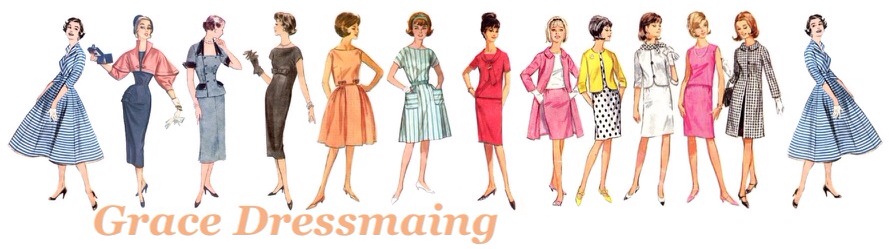
These vintage dresses look great in the pattern catalogue but will they flatter my figure?
What do you do when the new season's patterns come out? I used to eagerly flick through the pictures and pick a few that I thought looked good. Over the years I realised that I was probably approaching the whole process the wrong way round. Rather than responding to what was on offer I began to start the process by thinking what works on my body shape. With the availability of patterns online, both new and vintage, we are spoilt for choice: we can have whatever suits our figure and the garment's intended use. With this in mind, when I use comical patterns I decide what I want and then set about finding it. Rather like the weekly grocery shopping: we all know the pitfalls of going to the supermarket without a list.
I'm sure you're familiar with the 4 basic body shapes, and there are lots of 'rules' about what you should and shouldn't wear depending on your shape, whatever your size balancing proportion is the ultimate goal when selecting a becoming pattern.
Consider the 4 basic body shapes and then the 4 basic dress designs, how can each one be adapted to suit each shape? Which of the chemise designs would be best for your shape? If the answer's none! sketch out a chemise that would work for you.
Although you will find that one of the 4 basic dress designs suits your body shape most readily, all of the 4 design types can be adapted to suit all of the four body shapes. Below is the basic princess style adapted for all four body shapes. The adaptations are so effective it is not easy to spot which is the hourglass figure (it's not the lady second from the left).
When considering body shape do remember that you need to consider how the profile and back will work, not just the front view.
In identifying what your ideal pattern types would be it's also worth undertaking some of the following:
- rummage through your old photo albums, what outfits have looked good on you?
- go to a huge department store and try lots of different shapes on, even things you wouldn't normally: sometimes we form and hold opinions about what suits us that might need rethinking. When you go take a notebook and camera: in the changing room you can photograph yourself wearing the garments and make notes about fabric composition and the placement of darts. Once you're back at home analyse what elements are becoming: basic silhouette, colour, collar/ neckline, hem/ sleeve length;
- do you have any garments in your wardrobe now that generate complements; look for patterns that are similar to this. If the garment is old you can simply unpick it and use it to create your own pattern.
- Sketch lots of different silhouettes onto a croquis of your figure to see which shapes help to create a balanced proportion.
In reality the back of pattern envelopes will give you a much clearer idea of how the pattern will work for you; the colours, fabrics, model, lighting and editing of the photo draw us away from the information we really need to know: what are the garment's lines?
Once you've considered some of the above you're certain to find perfect patterns for you.
Follow Grace Dressmaking